Progressive Theme Study of Apples in the Kindergarten and First Grade

Study led by K/1 Teachers Anna, Elisa, Marisa, and Maryanne
How many ways can one consider the apple? Turns out, many, many ways if you are a kindergartener or first grader at Miquon!
 Like any good unit in Progressive education, the K/1 Apple Study was immersive and interdisciplinary – meaning that through this one topic children could grapple with math, reading and writing standards.
The apple study started in early October when our K/1 teachers tapped into the children’s background knowledge and natural curiosity. Children already knew a lot about apples, but they had many wonders like, “Why are apples different colors?” and “Do apples like to be picked?”
Full of great questions to dig into, the groups headed out to Solebury Orchards for some field work. By spotting each other on large ladders and carrying big bags of apples together, the group came home with hundreds of apples!
The learning didn’t end when the apples were picked because field work is never a “once and done” at a Progressive school. It’s a jumping off point for further study. So, when the children arrived back at Miquon with their apples, the study continued.
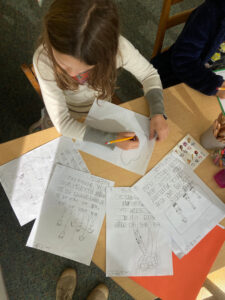 First, the children wrote about the experience. Our kindergarteners started with creating illustrations of their orchard experience and later added words to describe the illustrations. Our first graders engaged in a Writers Workshop unit where they crafted detailed, multi-page stories about our trip.
Anna explains: “Each writing session began by meeting with their writing partner to share their work, reflect on a prompt, ask each other questions, and brainstorm. Within minutes they were so inspired by something their partner asked that they could not wait to get started! This group’s energy has made for an empowering writing space, where they independently (and proudly) get paper as needed, seek out resources (i.e. Fundations sound cards), and ask to keep writing their stories during Rest and Digest.”
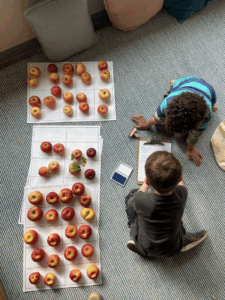 Next, the children worked with the apples in math to answer one of the group’s big questions: “How many apples did we actually pick?” The children partnered up and worked together to count their own bags of apples. Some counted by twos, while others arranged their apples in rows of 5 or 10. Teachers observed for one-to-one correspondence and asked everyone to record their totals; first graders took on the additional challenge of recording their numbers in at least two ways, such as with tally marks and a ten frame.
Later, the groups worked together to add up the total number of apples the class had picked. They used Unifix cubes to build each number, grouped quantities by tens, and used hundreds charts to guide their work. “We don’t typically work with such large numbers at this point,” Anna noted, “but they were eager for the challenge and delighted to be getting their hands on some really big numbers!”
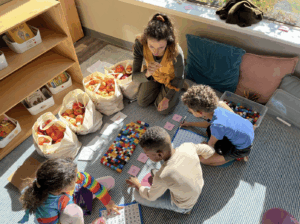 Finally, as Marisa put it, “After counting the apples, it was time to make some of them disappear!” The children made apple sauce, apple butter, apple muffins and apple crisp! While these activities look like sheer fun, they are also filled with learning. Children practiced fine motor skills by washing, peeling, coring and chopping apples. They applied math concepts as they measured ingredients and discussed fractions and quantities.
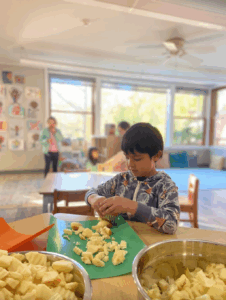 Through this month-long study, children saw how a single object — an apple — can become a doorway into curiosity, collaboration, and deep academic exploration. Thanks to our K/1 teachers – Anna, Elisa, Marisa and Maryanne – for guiding the children through this very rich and fun experience.
Oh, and in case anyone is left wondering… the children picked almost 500 apples!
