Science
Our science curriculum is an adaptable and evolving resource focused on using the scientific process to help students better understand their world. It provides a scaffold for learning experiences while remaining flexible enough to incorporate student interests, new opportunities, and emerging ideas in science education. Its current stage of development is heavily influenced by a variety of sources. These include Miquon’s environment and rich traditions, current research on science literacy, progressive education practices, student interests and the wisdom of our experienced staff.
View The Science Curriculum Scope and Sequence, which uses specific terminology from Project 2061: Benchmarks for Science Literacy, the Pennsylvania Department of Education Standards, and the NYC Department of Education has been used to describe key ideas already in place.
We recently celebrated the 100th Day of School by coming together for one of our favorite traditions: the 100th Day Obstacle Course, hosted by the ¾ groups and founded by beloved Miquon teacher, Sherry Moman. 💕
Groups also marked the milestone in their own creative ways: counting with 100 materials, building with 100 objects, designing their own 100th Day activity centers, stringing 100 Cheerios into stylish necklaces, and even coming up with 100 movements for the group to try! Children also reflected on their favorite memories from the first 100 days.
Cheers to the first 100 days—and here’s to a great rest of the year! 🎉
#themiquonschool #foreveramiquonkid #progressiveeducation #independentschool

🚨Proud alumni moment! 🚨 From speaking at graduation to speaking at the most recent Board of Education meeting—Naveh `25 and Evan `24 continue to use their voices with courage and conviction.
Now students in the School District of Philadelphia, they recently spoke out against the proposed closure of their middle school.
Bravo to them both for advocating for themselves, each other, and the world!
#themiquonschool #foreveramiquonkid #progressiveeducation
🍁 Sap season is our favorite season! 🍁
Each year, our K/1 students engage in the beloved tradition of tapping maple trees on campus.
Through this process, children learn by doing. They observe the first drip of sap, ask questions, share ideas, and discover together how sap becomes syrup. Along the way, they build not just knowledge of the steps, but deeper understandings of scientific inquiry, research, and how to represent their learning.
The best part? A tasty treat at the end, of course! ✨
#themiquonschool #foreveramiquonkid #progressiveeducation #independentschool
👀 Sneak Peek Alert!
Our 5/6 has been planning, creating, and documenting their Personal Projects for weeks. Today is the big reveal!
Before the fair begins, here’s a preview of the work happening at home:
🎵 Writing, recording, and layering an original song on electric guitar and drums
🚀 Designing a model rocket using CAD and bringing it to life with a 3D printer
🎂 Baking a different cake each week while learning to measure, prep, level layers — and taste test (with neighbors happily benefiting!)
We can’t wait to celebrate their curiosity, commitment, and creativity at today’s Personal Project Fair.
#themiquonschool #progressiveeducation #independentschool
At last night’s Curriculum Night, families stepped into the role of learners and experienced math the way our students do every day.
In small groups, they rotated through classrooms, engaging in hands-on number sense activities at each stage. Parents worked with materials, collaborated with one another, and learned alongside our teachers--bravely diving into math themselves.
By the end, families saw how we intentionally build number sense and deep understanding from Nursery through 6th grade.
We’re grateful to our teachers and families for making this night happen! 💛
#themiquonschool #ProgressiveEducation #IndependentSchool
Our 3/4 is diving deeply into PA history through their theme study this year, with a special focus on the Lenape people, the original inhabitants of this region.
The children have built a rich understanding of Lenape life through research and hands-on experiences. They visited the recreated Lenape village at Churchville Nature Center and hosted Chief Bluejay of the Lenape Nation of PA, who shared Lenape stories, customs, Unami words and traditional games. We were also lucky to welcome musician Krista Nelson, who has been studying indigenous musical traditions. She brought wooden flutes to play and told an interactive folktale about how the Lenape imagined the invention of the first flute by the woodland creatures.
Now, the 3/4 is bringing bringing this knowledge into a historical fiction writing unit. Each child is creating a character and crafting a story set in a Lenape village long ago, using research to ensure their writing is thoughtful, vivid, and historically grounded. From imagining seasonal work and winter preparations to picturing what this land looked like 500 years ago, students are blending research, imagination, and empathy as young historians and authors.
We are proud of the 3/4’s dedication to this meaningful work!
#themiquonschool #progressiveeducation #independentschools
Students recently wrapped up their 2026 Caldecott unit in library class!
The Caldecott Medal was named in honor of nineteenth-century English illustrator Randolph Caldecott. The medal is awarded annually by the Association for Library Service for Children, a division of the American Library Association, to the artist of the most distinguished American picture book for children.
Each year as part of Miquon’s library program, students and staff form a mock Caldecott committee. This year, they looked at eight amazing contenders for the Caldecott medal and voted on which three books were the best contenders for “the most distinguished American picture book for children” published in 2025.
Shown here are students in the 3rd and 4th grades checking out the books and making their selections!
#progressiveeducation #phillyareaschools #progressiveschool #HandsOnLearning #independentschool #foreveramiquonkid #themiquonschool #caldecottmedal #caldecott @americanlibraryassociation
The 5th and 6th graders continued their theme work on immigration and migration last week with a field trip to Philadelphia’s Italian Market.
The students found themselves immersed in the rich visuals, stories, and experiences that make the 9th Street community unique - among other stops, they saw intricate murals and learned their histories, they stepped into a church built in the 1840s, and they explored both a Mexican shop that sold traditional items and a shop that sold coffee from the owner’s family farm in Nicaragua.
We hope that by exploring the stories of people who made the market what it is today, our students feel inspired to learn more about how everyday people make communities special and resilient.
#progressiveschool #HandsOnLearning #progressiveeducation #independentschool #italianmarketphilly #phillyareaschools
Approach
To support the development of curious, life long learners, Miquon students actively experiment to better understand the world. The science program emphasizes critical thinking processes that give children the skills they need to explore their own questions.
These essential questions guide the development of worthwhile experiences for Nursery through 6th Grade students:
- How can we observe, question and experiment to better understand our world?
- What lives, grows and breaks down at Miquon?
- How do parts of a system affect each other?
- How can we create what we need or want?
- How does science work? How does science information change over time?
Specific areas of study are selected through the interplay of a variety of factors (including, but not limited to): personal relevance to students’ daily lives, local and global events, the availability of resources, and student and teacher interests. The disciplines of biology, chemistry, physics, ecology, engineering, and art are woven throughout the curriculum. Core ideas in these fields are investigated and revisited in age appropriate ways to build the foundation for a broad and nuanced knowledgebase.
The Art and Science Show
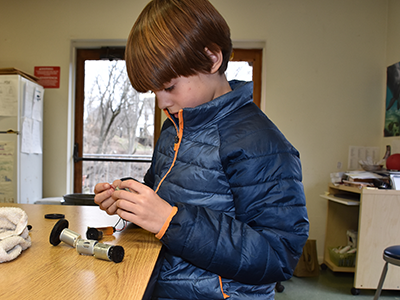 The Art and Science Show is an event in the spring that showcases work from every child in the school. The art presentation is curated by the students and the art specialist teacher. The science show has had a variety of iterations over the last few years, but it always features reflective learning exhibitions from fifth and sixth grade students. These exhibitions may feature inventions developed by students, extensions of science projects completed earlier in the year, live demonstrations, or creative exhibits that educate visitors about a specific topic. Younger students are also invited to present their projects and inventions, but it is not mandatory.
Science Choice
In addition to scheduled classes, many children also enjoy visiting the science room at lunch choice. The science room is open two to three days a week. Students visit to continue projects from class, build new creations, work with computer programs, read books and spend time with the live animal visitors.
Minicourses
Minicourses are elective courses for children held for an hour on Friday mornings in eight week installments. Topics for these courses may be suggested by teachers or children. Some science related minicourses held over the last few years include: SCRATCH-an introduction to computer programming created by MIT, Google Sites, Woodworking, Art and Sculpture in Nature, Baking Bread, Move It–a dance and fitness class, Bird Watching and Hiking, Paper Airplane Design, Building Things That Go, and Chemistry & Crystals.
Science Blog
Want to learn more about the latest with Science Kate? Check out pictures, kid projects and the other happenings posted to the Science Blog.
Science Blog
- The Miquon Kids’ Research Journal Volume Two
- Spotted Lanternflies and Children
- The Miquon Kids’ Research Journal
Curriculum Report
The curriculum report is the teachers’ review of the entire year, looking back and making observations after their plans, projects, problems, and revelations are long over. One of the distinguishing features of this report is the great extent to which each teacher’s style, focus, and personality come through in this retrospective narrative. Check out the Science Curriculum Report.


